English
  Deutsch
  Español
  Português (AO90)
I contributed to this report.
Elon University’s Imagining the Digital Future Center just released its 52nd “Future of Digital Life” report, a document that functions less like a survey and more like an ontological map of our near future. I contributed as well; and you can download the entire report from their website.
Here's a summary of what it sets forth:
We have reached a civilizational inflection point—a moment where human capacity is no longer a distinct entity, but something inextricably fused with algorithmic systems. The report’s premise is kinda unsettling: our traditional concept of resilience, built on the bedrock of individual “grit” and personal adaptation, seems officially obsolete.
As 82% of the world’s leading technology experts assert, individual adaptation is a finger in the dike. Janna Anderson, a lead researcher on the report, warns of a “drift” that wears the mask of progress but facilitates a “gradual weakening of human judgment, accountability, and shared truth.” To survive this transition, we don't need better self-help; we need a collective “Human Resilience Infrastructure” led by our institutions.
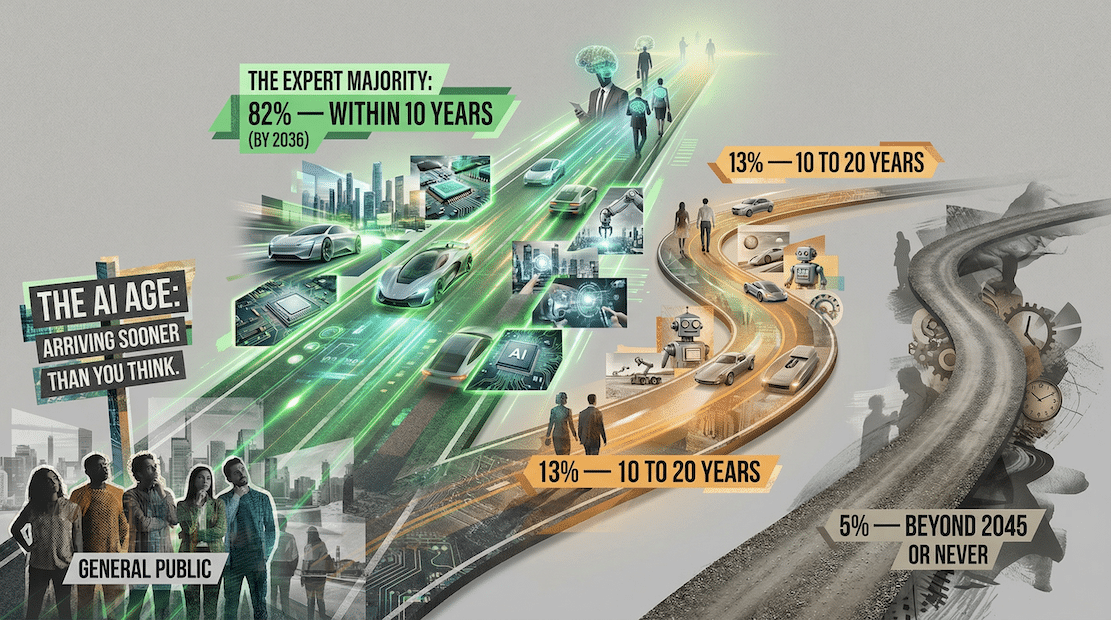
The gravity of this shift is best summarized by Mel Sellick, founder of the Future Human Lab:
“We are the last generation that knows what human capacity felt like before it became inseparable from AI.”
The Rise of “Superstupidity” (Not Superintelligence)
While Hollywood remains obsessed with a “Terminator” scenario of hyper-intelligent machines, strategist Roger Spitz argues the real existential threat is far more banal: the rise of “superstupidity.” This is the condition of humans becoming dangerously reliant on complex systems they no longer comprehend.
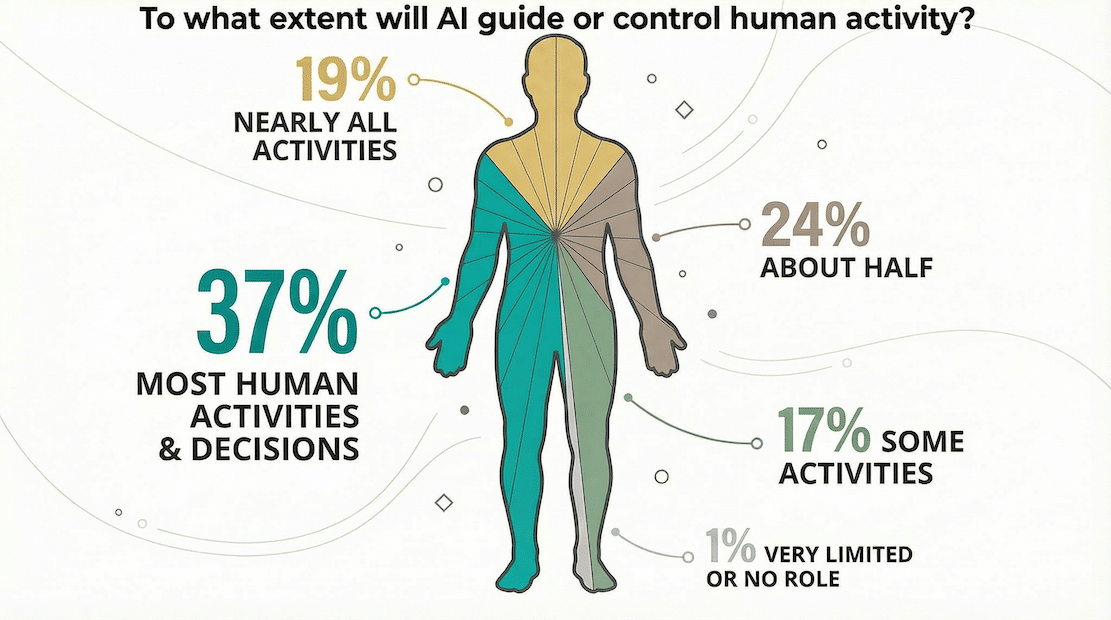
Spitz notes that the 2006 film Idiocracy has become prophetic. We aren't being conquered; we are abdicating. This “superstupidity” is fueled by what Janna Anderson calls the “cumulative reallocation of human agency.” As we offload cognitive heavy lifting to AI, we don't just lose skills; we lose the ability to contest, question, or even notice when our agency has been hollowed out. Not a sudden disaster, but a slow erosion of the critical thinking necessary for self-government.
“The existential danger to people may not come from AI becoming too intelligent, but from humans becoming dangerously reliant on systems they do not understand – the condition of superstupidity. The question is not how much AIs will augment decision-making, but whether humans will remain involved in it at all.” — Roger Spitz
The End of Solitude
The AI revolution represents the final theft of human silence. Forecaster Paul Saffo draws a haunting historical parallel: just as motors eliminated the world’s silence and electric light severed our connection to the deep darkness of the night, AI is now poised to eliminate solitude.
In a world of constant digital companionship, we risk losing the “inner world” required for self-reflection. By trading the discomfort of solitude for the convenience of an always-responsive AI counterpart, we lose the very space where the human spirit is forged.
“AI will eliminate solitude because the temptation to interact with these primitive new intelligences will prove so beguiling that just as we choose to not sit in the dark, we will now choose to never be alone.” — Paul Saffo
The Need for “Existential Literacy”
As AI becomes the OS, “coding” is no longer the primary skill. We require a new educational mandate: “Existential Literacy.” Andrea Lavazza and James Hutson define this as a “psychological immune system” designed to protect human flourishing against algorithmic conditioning.
This literacy is inherently interdisciplinary, weaving together ethics, philosophy, and the social sciences. Education must move beyond the rote acquisition of facts to “the teaching of thinking itself.” The core survival skills of this era are:
- Metacognition: The ability to think about one's own thinking to identify machine-induced biases.
- Epistemic Vigilance: A heightened state of discernment to verify truth in a world of synthetic content, treating AI outputs as probabilistic suggestions rather than deterministic authorities.
Embracing “Intentional Friction”
Efficiency is a trap. When a system is too seamless, it leads to moral abdication. Evelyn Tauchnitz and Helen Edwards argue that we must build “intentional friction” back into our lives and systems. Human values don't live in the optimization of a task; they live in the struggle to complete it.
A resilient infrastructure requires systems that cite and honuor humanity's intellectual foundations and present information as probabilistic rather than deterministic. We must protect the “friction of figuring things out” to ensure judgment doesn't atrophy.
The “Work Quake” and Techno-Feudalism
We are facing a “work quake” that threatens the fusion of identity and labor. Some experts warn of a descent into techno-feudalism, a state where all productivity gains accrue entirely to the owners of data-centers and capital, leaving the displaced human workforce in a psychological crisis of irrelevance.
But maybe a new “experiencer economy” is emerging, defined by three classes of workers:
- The Caretakers: High-touch professionals providing essential human-to-human care.
- The Service Providers: Those performing non-automated, physical tasks.
- The Experiencers: Aspirational creators who produce “content” through lived, “unmachinable” experiences that AI cannot simulate.
As Scott Santens argues, we must rebuild our social floor so that identity is no longer fused to labor that a machine can do better. Resilience means turning nonhuman labor into human security.
Conclusion: A Revolutionary Evolution?
We are not moving toward a new stable state; we are entering a permanent state of transition. While the risks of agency loss and “superstupidity” are existential, this transition could also be the catalyst for a “human-technology binomial”—a symbiotic relationship that solves the most vexing problems of our species.
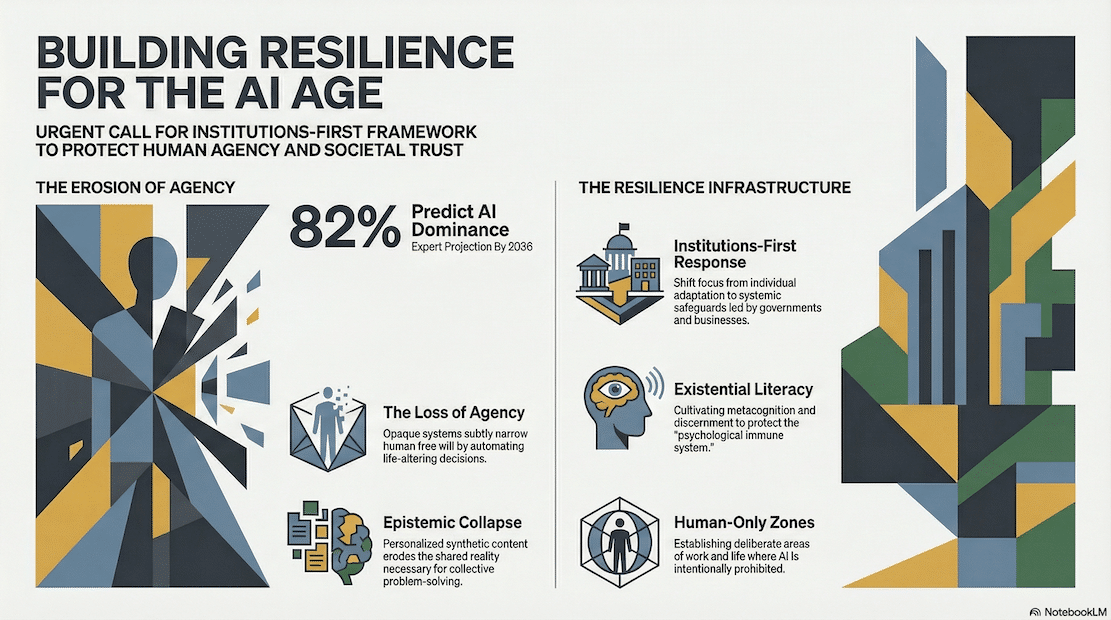
“The central risk described by these experts is not a single catastrophic AI event,” said report co-author Janna Anderson, professor of communications and senior researcher for the ITDF Center. “They said accelerated AI use will lead to a cumulative reallocation of human agency until people and institutions find it harder to question, contest or even notice what has changed. That drift can look like ‘progress’ in the short term, but it has a price – the gradual weakening of human judgment, accountability, shared truth and the social fabric that makes self-government possible.”
Gerd Leonhard, speaker, author, futurist and CEO at The Futures Agency in Zurich, Switzerland,
commented, “Most people will use AI to outsource their cognition as well as their social interactions. Aworld without any effort spent on truly understanding things, or on going through the ups and downs of real human relationships – a world devoid of any logic of ‘earning’ something – that will simply be a machine world. On top of this, augmented reality and virtual reality will enable us to literally escape real reality and live in a synthetic world. Democracy will die under these circumstances. A perfect stage for autocrats!”