English
  Deutsch
  Español
  Português (AO90)
Nice to see you here!
Gerd Leonhard – For the Human Future. Public Thinker, Advocate for Humanity, Film-Maker, Author and Keynote Speaker. In an era defined by exponential technologies and radical shifts, Gerd serves as a vocal defender of human values, ethics, and agency. Through his cinematic presentations, short films and real-time curations, he makes the argument for The Good Future—a world where technology serves the 5Ps (People, Planet, Purpose, Peace and Prosperity) rather than the other way around. While others sell the “next big thing,” Gerd advocates for the “only big thing”: our continued humanity.
DownloaD TOPIC PDF (ENG) PDF (DE) PDF (ES) PDF (PT) PDF (FR) PDF (KR)2026: Challenges ☯︎ Opportunities
WHY AND HOW THE FUTURE IS BETTER THAN WE THINK
2026 is not merely a pivotal year – it marks the emergence of a new world order, a fundamentally new architecture of how the world actually works. Fueled by dramatic shifts in how the United States engages with the international system it once played a leading role in designing , there is a growing perception that traditional norms and institutions are under fire. As political communication becomes faster, more erratic and more public—often unfolding on social media—and long-standing diplomatic practices are ignored, questions arise about trust and global stability. If alliances strain even more and trust keeps eroding, how long before democracy fractures even further—and what follows, then? But which paradoxically positive outcomes might emerge from these turbulences (such as the much-debated United States of Europe)? In addition, the climate emergency is now undeniably real, accelerating, and unforgiving. Lastly, while humanity stands to prosper enormously from the widespread availability of powerful AI tools, we must also confront the profound risks of pursuing Artificial General Intelligence. Would AGI lift humanity to unprecedented heights, or quickly render us obsolete? The fight for The HUMAN Future is on.
This keynote doesn’t just diagnose the challenges – it shows the path forward.
The Future of Europe
YES WE CAN, and YES WE MUST. NOW.
Our world is changing faster than ever, fuelled by deep geopolitical shifts, wars and autocratic ‘leaders', the accelerating climate emergency, and the hyper-exponential pace of technological transformation and the confusion that comes with the meteoric rise of AI. Many pundits set forth that this future is basically one prolonged misery – and in my latest manifesto, I explain how The Bad Future is driven by dependency on systems that no longer work — broken ‘enshittified‘ platforms, extractive tech models, and of course a dramatically negative turn in the global role of the United States. As conflicts, AGI and climate pressures accelerate, dependence on the U.S. has become a strategic liability for Europe. Europe's future must be shaped in Europe, and by those able to guide and regulate wisely, invest holistically and align exponential technologies with societal goals.
This keynote argues for a new strategy. For example, Europe must stop importing digital ideology and start exporting its own rules, standards, and values. Not as a moral gesture or ideology, but as an economic and geopolitical necessity. The choice is simple: copy the dysfunctional American model — or design Europe as a sovereign force. But how could we even rebrand the future as ‘good'? How could Europe take the lead, and go beyond the amazing science and the cool tools towards more collaboration and more ‘telos'? I believe that the 5Ps (people, planet, purpose, peace and prosperity) are the key.
Beyond Knowledge: Being human is our key advantage
FROM KNOWING TO UNDERSTANDING: WORK IN THE AGE OF AI
Artificial intelligence is rapidly commoditising simple, fact-based knowledge work rooted in logic, patterns, data, and information. Anyone with an Internet connection can now query almost anything and tap instantly into the global data stream. This is both a promise and a peril—what I call Hellven. Tools like Google’s NotebookLM make gathering and summarising knowledge effortless, but they could also encourage effort avoidance, fake expertism, and content “slop.” Yet of course, things like embodied context, common sense, meaning, and purpose remain stubbornly non-algorithmic i.e. what I call an ‘androrithm‘.
As a result of exponential gains in AI, explicit knowledge is no longer a competitive advantage. What matters now is implicit, tacit, holistic and embodied understanding. It’s no longer about what we know, but what we understand; not just intelligence (solving problems), but consciousness (experiencing things and making meaning). Being smart still helps—but being more human helps more. This shift will transform work, especially white-collar roles built on routine cognition. As I often say: if you work like a robot, a robot will take your job. The future of human work lies in what machines can’t, won’t, and shouldn’t do. For knowledge workers, this is both liberating and super-demanding: less memorising, more sense-making; less information, more wisdom.
This new keynote explores why we must move beyond knowledge, why HECI (humanity, ethics, creativity, imagination) now matters more than STEM alone, where new jobs will emerge, and why—within a decade—work will no longer be our primary source of identity, meaning, or purpose
Intelligence vs Consciousness: Protecting our Humanity as we move towards AGI
Just because we could does not mean we should!
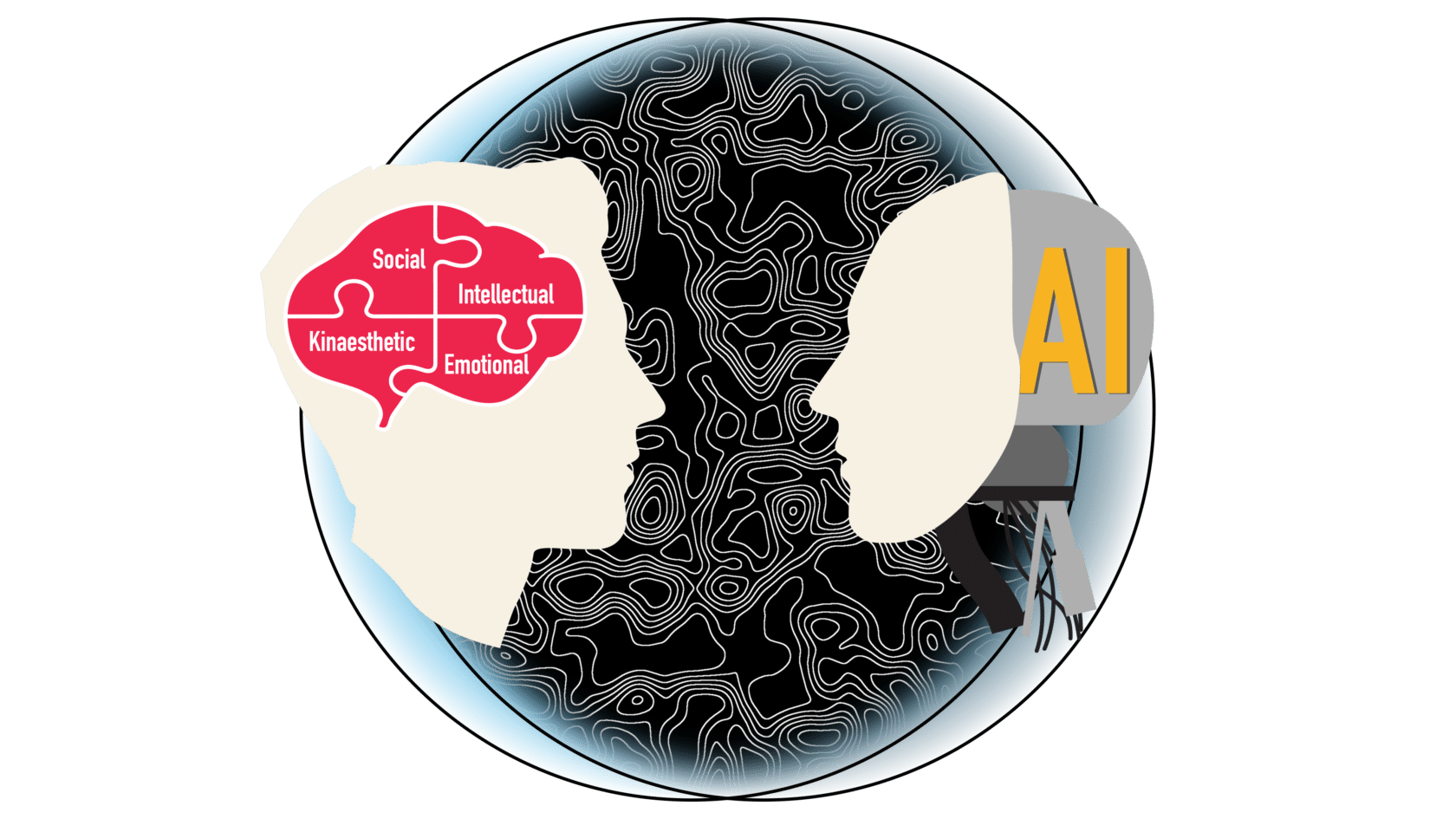
This talk discusses the difference between intelligence (doing) and consciousness (being). It explores the tensions between technological possibility, desirability (purpose) and moral responsibility. It warns that in our rush to create super-intelligent machines, we risk foregoing what I call “the art of being human”, and fall prey to techno-optimistic reductionism and obsessive cognitive offloading. This talk fits squarely into the current AGI debate, proposing that we ask a deeper question: Are we building AGI to ensure human / planetary flourishing and to extend human values—or to replace human agency, and to build ‘digital humans'. Maybe intelligence can be coded but consciousness…not? Wisdom, in my lens, lies in choosing what should be automated, augmented or virtualised—and what should remain sacred. AI intelligence might be a good thing, but conscious AIs would be a terrible mistake.
Beyond AI: What really matters in technology & society
THINK BEYOND THE OBVIOUS. IMAGINE. PREPARE.
AI is now a general purpose technology, and the platform ‘for everything' – yet AI is clearly not the panacea or the magic wand many eager entrepreneurs, tech-moguls and Silicon Valley investors have envisioned. It's time to look beyond AI. While we certainly need to get ready for the 5 hyper-exponential technological game-changers (quantum computing, nuclear fusion, synthetic biology & nano-technology, genome editing and geo-engineering) we also need to ask this crucial question: What kind of future do we want? In this talk, I outline what to expect by 2030, while correlating the technological breakthroughs with wider societal developments such as ‘the new USA‘, the rapidly accelerating climate emergency, technology regulation, global governance and global consciousness, the rise of GenY & Z, global demographics and various important geopolitical mega-trends.
DIGITAL LABOR: AI AGENTS, AUTOMATION AND WORK
WHY ‘SMART' MACHINES STILL CAN'T REPLACE HUMANS
Digital Labor (Salesforce's definition: “A digital workforce of intelligent AI agents that augments the human workforce, and transforms the way work gets done”) is all the rage: Swarms of AI agents poised to tackle all the routine work that once bogged down human time and productivity. From drafting simple contracts and NDAs to interpreting scans and MRIs, hundreds of vendors are painting a utopia where drudge tasks vanish, productivity soars, and boardrooms celebrate a future with with a lot less “expensive” (and pesky) humans. My hunch is that behind the glossy demos and the “frontier firm” pitches lies a techno-optimistic reductionism: swap flesh-and-blood employees for lines of code, automate oversight, ethics and authenticity into oblivion, and watch more profits funnel into the corporate coffers.
But of course, in real life, many so-called commodity tasks demand embodied judgment, social nuance, holistic understanding and contextual awareness—capabilities that – being devoid of agency and consciousness – no algorithm can reliably emulate. When today’s glitchy chatbots can barely book a meeting without crashing, the dream of wholesale human replacement feels more like a pipe-dream than a panacea. But, yes: will that change, and when?
We must ask: Who benefits when “the full automation of the economy” becomes more than a Silicon Valley VC fad? If real intelligence is social, embodied and holistic, then “machine smartness” is merely a power tool—useful, yes – but unthinking, unaware and uncaring. And let's remember that the race toward AGI isn't really about business innovation; rather, it increasingly looks more like an arms race in which investors and super-funded startup CEOs dream of human labor as an obsolete line item in a pitch deck. So: Before our jobs—and our dignity—become disposable commodities, I think it’s time to insist that the spoils of “post-labor prosperity” (??) be shared, not annexed ir hoarded. Let’s resist this digital coup against the very concept of work…and remind our new AI wranglers that consciousness, not code, remains uniquely human.
Synthetic Everything: An Algorithmic Society?
Artificial Intelligence can generate media and content that is nearly indistinguishable from human creations. Over 50% of the content on the Internet is already generated by AI (as of early 2026). Globally, an estimated 50% of consumers already get their ‘news' from social media and various mobile/video platforms that are essentially programmed by AI, with very little human supervision. The Internet is bound to change forever, with AI at the helm. Manufactured and fake narratives are certain to lead to stock market disruptions and railroad political decisions and elections. In addition, augmented and virtual reality, the metaverse as well as spatial computing will soon allow us to transcend spatial (and thus, human) limitations and literally be anywhere, anything, anytime, with anyone. But if most content/media/narrative is synthetic i.e. generated by algorithms, and most decisions are made by algorithms (trivial or more essential, alike), and AI's ‘black box' extends over most of our daily activities, how can we still retain what makes us human? How can we connect to each other directly… in real-life? What will happen to democracy? How will we pursue real happiness and deal with the increasing loneliness syndrome? In this talk, I will outline what may happen in the near future and suggest ways that the trend towards dehumanisation could be halted, how exponential technologies could be deployed more wisely, and generally, why human connectedness is so essential. “Algorithms know the value of everything but the feeling of nothing”. Read this related piece by Jeremiah Owyang (wow).
Examining Techno-Optimism
Too much of a good thing can be a very bad thing
Techno-Optimism (often coupled with accelerationism) is the increasingly popular belief that leaps in science – and the corresponding exponential advances in technology – can solve most if not all societal problems and that all technological progress will enhance human well-being. Therefore, it is important to not get in the way of technology unfolding at the fastest possible rate.
Proponents of Techno-Optimism such as the famed Silicon Valley venture capitalist Marc Andreessen assert that technology is the primary driver of growth and prosperity, advocating for a dramatically accelerated approach to technological development, in particular in areas such as Artificial Intelligence (AI). In contrast, I caution against this often cult-like approach to technology's importance, its over-reliance on data and computing, deep learning and ‘intelligent machines’, downplaying the drawbacks such as an increasing loss of trust in each other, disinformation (such as with social media), job displacement, privacy concerns, deep surveillance, and the very real outcome of general reductionism and dehumanisation.
Transcending the AI debate, I explain why we need a balanced perspective that considers both the super-exciting potential benefits and the likely devastating unintended or unplanned consequences of rapid technological progress, arguing for a more holistic approach that goes beyond mere economic or geopolitical power gains. Our views on what technology should or should not do are becoming crucial, as we head into a future where AI is at the center of ‘everything, everywhere ‘ – as many major players such as OpenAI seek to invent machines that are generally intelligent and capable of reasoning, surpassing human capabilities in all relevant tasks (HaltAGI presentation)
In this talk, I also dive into why I remain optimistic, and explain that while ‘embracing technology' will be crucial for making The Good Future a reality, I also think we must reiterate the urgent need for collaboration, and create incentives do the right thing (i.e. to pursue people, planet, purpose and prosperity, not just profit and growth) Exponential technological gains alone are not enough – we must develop science and technology while we pursue humanity at the same time. The Future is amazing humans on-top of awesome technology.
ARTIFICIAL INTELLIGENCE (AI), AGI AND THE FUTURE OF HUMANITY
AI is a general-purpose technology like fire or the printing press, and it's a new technology platform as well. It could be heaven, or it could be hell, depending on whether the tools will dominate us, or whether human telos (the purpose) will prevail. The more power we have, the more wisdom we'll need! And that's true no matter whether how will pursue AGI.
Science fiction is increasingly becoming science fact as smart machines – both physical and virtual – take on more tasks once thought impossible for a “digital entity” to accomplish. As a result, knowledge work is transforming at a rapid pace, forcing us to reconsider what it means to be human – in our daily life, in our professions and in our organisations. What will happen if and when machines become ‘generally intelligent'?
We must embrace these new possibilities while also preserving and protecting our humanity. We need proaction and precaution. We must define new values and goals that transcend increased efficiency or the resulting financial gains. I think it will be our androrithms, our uniquely human skills and traits that will make us invaluable in this coming age of AI, not just our ability to command technology or to become faster by using it (or even to merge with it).
In this customized talk, I guide my audience through what is important (and real) versus what is utopia or plain false (or dangerous) when it comes to AI. I delineate how we can harness the power of AI to further human (and planetary) flourishing, happiness, success, and well-being. I set forth why I believe the future holds great promise if we play our cards right and pursue People, Planet, Purpose, and Prosperity.
GERD'S KEY FORESIGHTS: THE NEXT 10 YEARS
- Exponential technological change: It could be heaven, or it could be hell. What you should expect regarding regulation and policies, and why Digital Ethics is existential.
- IA (intelligent assistance) versus AI, versus HI (human intelligence). Why using AI is really all about competence, not consciousness, and why AGI might pose a serious conundrum.
- Virtuality: AR/MR/VR, the Metaverse and Apple's Vision Pro: opportunity versus hype, versus feasibility
- A new capitalism? Examining the coming shift beyond GDP / Profit & Growth towards the 4Ps: People Planet Purpose, and Prosperity.
- The Sustainability Revolution: Big Blue/Tech + Big Green = Big Future (Green is the new Digital).
- The coming human renaissance: rebooting education, training, learning, and HR. Life with/after automation and AI. Why humans will still matter!
- Don't mistake a clear view for a short distance. A reality check on ‘big promises' such as GenerativeAI, self-driving, i.e., autonomous vehicles, NLP/ computer language comprehension etc.
- From efficiency and optimisation, to agility, resilience, and creativity. The future of work and skills. Our ultimate job is to be human (i.e., not to be like a machine).
- The coming convergence of biology and technology, rebooting healthcare, pharma and life sciences.
This talk is constantly updated to reflect the latest developments
DESIGNING THE GOOD FUTURE: THE 5Ps
How People-Planet-Purpose, Peace and Prosperity is the key to the Good Future
Fueled by recent geopolitical conflicts, the urgency to address the accelerating climate emergency, and the mounting societal challenges of technological hyper-transformation (in particular, AI), the world continues to change at a mind-boggling pace, and confusion reigns.
Once unthinkable climate-emergency measures such as new carbon taxes (for aviation or even for eating meat) are increasingly likely, concerned citizens (especially GenY) around the world will push for real change. CEOs are touting their commitments to stakeholder values, but many doubt that corporate leadership toward a better future is sincere enough; resulting in a political power shift that now benefits autocratic regimes.
What kind of future do we want? Is our current economic logic even suitable for the future? Will the traditional model of ‘free and open markets' deliver solutions for these complex global issues? Is this approach fit for the future?
I believe that we must look beyond outdated categories such as socialism, capitalism, and/or liberalism to design a new economic logic and reboot our stock markets as we transition from the suicidal single bottom line of GDP growth to what I call the 5Ps: People, Planet, Purpose, Peace and Prosperity. This keynote will dive into my latest learnings on The Good Future (as well as the Bad Future🙂 and help show the way forward.
Watch my various Good Future films, talks and videos here.
THE 10 ESSENTIAL FACTS ABOUT THE FUTURE
The most important future foresights: critical optimism and inspiration
In these confusing times, where AI-infused media is constantly spreading disinformation and fabricating fake realities, it is essential to learn how to see through the hype and unmask false promises. In this talk, I share my continuously updated list of ‘facts & truths' about the future, such as:
- Science and technology alone will not save us – we need the tools AND we need the TELOS!
- Understanding the future is both an art and a science. Imagination & intuition beats knowledge.
- AI tools are fundamentally labour-replacing, and we must prepare accordingly.
- Transcending our human limitations by technological means will not make us fundamentally happier. Transhumanism is a dead end.
- Until we change our reasons (the purpose), we won’t change our actions (and the resulting problems): We need to rethink our economic logic.
- A technology-centric, reductionist approach to dealing with human realities will inevitably fail.
- When it's about ‘intelligent digital entities', we should focus on competence (IA), not on consciousness (AGI)
THE FUTURE-READY MINDSET
Character Traits, Personality, Skills, and Attitudes: Your Mindset Contains Your Future!
While there is no such thing as “knowing the future,” nothing is more important to your future success than your mindset, your intuition, your imagination, and your overall future readiness. Looking at the Future is not about prediction, it's about being better prepared. That's something we can learn and practice.
In this popular talk, Gerd explains and shows how to develop the future mindset, and how organisations can dramatically increase their future-readiness.
The next 10 years will bring more change than the previous 100 years: driven by the 3 revolutions (digital, sustainable, purpose) as well as by simultaneous technological leaps in sectors such as AI, Quantum Computing, Synthetic Biology, Nanotech and Genetic Engineering and others.
THE 4 REVOLUTIONS: ARE YOU READY?
The next 10 years will bring more change than the previous 100 years.
We are warp-driving into a future, characterised by the 4 Revolutions: The Geopolitical Revolution (triggered the ‘new USA), The Digital Revolution (AI+++), the Green Revolution (sustainability & decarbonisation), and the Purpose Revolution (a new economic logic ‘beyond GDP', based on what I call People Planet Purpose, Peace and Prosperity, the 5Ps).
If indeed “the future belongs to those who can hear it coming” we must develop a future mindset, question our assumptions about what's possible, and boost our ability to better respond to the framework changes (not just to the individual pictures).
The future is no longer about tomorrow – the future is already here; we are just not paying enough attention yet! By 2030, we will have approx. 9 billion people connected at high speeds and very low cost. Virtual/augmented reality will be as normal as WhatsApp. Conversational AI and natural interfaces will be how we interact with computers, and the rapid convergence of online, virtual and real-life physical worlds will upend how we do everything, from working to travelling to shopping to healthcare to banking.
The power of exponential, general-purpose technologies such as AI and VR will become almost limitless – which is why we must start to focus on remaining human. Ethics and values will become the new product (just like green is already the new digital).
THE FUTURE OF WORK, JOBS, EDUCATION & TRAINING
Awesome humans on-top of amazing technology!
All too often, scientific breakthroughs, industry hype cycles, the latest technological achievements or economic growth agendas dominate discussions about our future. Yet, as the world is rapidly going digital and becoming increasingly virtual, I believe it is our humanity – our androrithms – that needs the most attention. It will be our humanness which will make all the difference, not just our technology. 2021's hype about the Metaverse is a good example: sometimes technology promises to give us everything we've ever dreamt of but ends up giving us little of what we really need.
Computers will inevitably outpace humans in mere processing power, logic and efficiency, and the End of Routine is a certainty. Thus, the ticket to our future is to become more human, not less; not to compete with the machines but to use their increased competence to handle those tedious commodity tasks better and faster. Yet I believe that machines, computers and algorithms should have competence, not consciousness.
What will happen to humans when machines become truly intelligent – or even ‘super-intelligent'? What about privacy, mystery or serendipity? What about emotions, intuition, imagination, and human agency? In this talk, I outline the challenges and present new ideas and feasible solutions.
Reminder: The biggest danger today is not that machines will eliminate us, but that we may become too much like them!
GREEN IS THE NEW DIGITAL, SUSTAINABLE THE NEW PROFITABLE.
How the decarbonisation of our economies is the biggest opportunity in this coming decade
Digital transformation is just business as usual. The next massive topic is Big Green: the decarbonisation of our economies and the gradually-then-suddenly departure from the fossil fuel era. 2024 will be when the gloves are coming off.
Get ready: wide-ranging new carbon taxes are inevitable (airlines, meat, personal carbon budgets etc.), and fossil fuel subsidies will turn into nature-positive investments. During the pandemic, we learned that being prepared for emergencies is essential – and that yes, we can indeed compromise and collaborate (if we must).
I set forth that the circular economy will be the only economy by 2030, and that ‘sustainable' is becoming the new ‘profitable' in the next 5 years (have a look at the stakeholder economy debates).
Any company that does not understand how this global move towards rapid decarbonisation will impact every segment of their business (from R&D to supply chain, from production to distribution, from marketing to branding), will wither and fade away. Those who don't understand what knowledge, skills, and mindset means, will quickly become dispensable.
In this talk, I explain why this tectonic shift is happening now, what it means, and how to get behind it and prosper in this fork-in-the-road decade which is coming up. Visit my new Decarbonisation / Green Hub. Watch this short film.
WHY AND HOW THE FUTURE IS BETTER THAN WE THINK
10 Reasons to be Optimistic. 5 Strategies and 3 Actions
For decades, film and TV studios have flooded the public with visions of a dystopian future. It's no wonder that people fear AI and robots. Add the streaming platforms, social media, pandemics, (re)globalisation, automation and geopolitical upheaval to the mix, and the result is a widespread belief that the future is mostly bleak. Read more about that here.
The fact is: Our world is not irrevocably destined to become a dehumanized hellscape ruled by AI, or some other Black-Mirror-like nightmare. Our future certainly isn’t fixed – we create it with our (in)actions, every day. If you look at the correct data, you’ll find things often are better than ever before.
The world is improving at a rapid rate. Sure, the world’s progress in the past 30 years is not all peachy and amazing – especially when seeing it in context with the Corona crisis in 2020. Yet, we are well on the way to reducing extreme poverty and hunger and chiselling away at many of the other woes that have plagued humanity since the dawn of time; including diseases, crime, and war. Indeed, we have a lot of reasons to be optimistic about our progress. In the next decade, I think we will have most of the tools we need (science and technology). Now we must acquire the TELOS (will, purpose, and wisdom).
So what can you do, as an individual, an enterprise, or an organisation, to make sure your future will indeed be bright? How will you turn these challenges/opportunities into positive action? If we are (or to become) what we believe we can be, how do we change our beliefs and mindsets?
DIGITAL ETHICS AND THE FUTURE OF HUMANITY
Our future could be heaven, or it could be hell – it’s our choice!
Science fiction is increasingly becoming science fact. Consider the dramatic technological advances in robotics, artificial intelligence, human genome manipulation, autonomous vehicles, and quantum computing. By 2030, the power of exponential technologies will become almost limitless!
The ethical and humane use of technology can no longer be an afterthought but instead, an existential challenge. If we define ethics as, “Knowing the difference between having the power to do something and doing the right thing”. Who do we want to make these critical decisions? Should it be the algorithms and profit incentives that determine our fate? Who will be mission control for humanity?
To paraphrase Apple's CEO Tim Cook, “Technology can do great things, but it does not want to do great things…it doesn't want anything”. In a world where technology will increasingly define every aspect of life, who do we want at the helm?
If we define ethics as, “Knowing the difference between having the right or the power to do something and doing the right thing”, who will decide what is right, and who will be “mission control for humanity”?
In my keynotes often take a meta-level view of the next 5-10 years, and then zoom into the core subjects and themes of each event, ending with action items and recommendations. I can cover many different sectors such as society, policy, business, technology (in particular, artificial intelligence), climate change + green futures, the future of jobs, work and education, learning, and human resources. For some good examples, watch these videos: The Next 10 Years, and The Future of AI and Humanity.
My keynotes can be held virtually, using my unique and critically acclaimed keynote television approach. **** All talks are customised for each specific client and their audience.
Try my new video search engine or my other chatbots here, or just reach out to me directly to discuss a possible collaboration.
ENGAGEMENT OPTIONS
VIRTUAL OR IN PERSON – LIVE or PRE-RECORDED
AVAILABLE ENGAGEMENT & PRESENTATION FORMATS
The cost of an engagement depends on many factors: event location, the degree of customisation required, the audience, location, venue size, preparation time, and the overall event context. We have an option for just about every budget:
- A virtual/online keynote with customised background visuals (20-60+ min), live via remote video or Pre-Recorded, depending on your schedule and requirements. Gerd often delivers high-definition recordings followed by live online Q&A sessions. Please inquire for further details.
- Live-on-stage / On-location keynotes: a) with customised visuals (30–90 min) b) A speech without visuals or media c) Gerd's popular super-keynote format (requires extra-wide LED walls).
- A ‘Fireside-Chat with Futurist Gerd': no media, or presentation, only conversation-style, hosted by a suitable and experienced presenter in real life or virtually.
- A virtual panel or webinar participation (no speech, or presentation)
- Futurizing Seminars or Workshops
- Virtual Advisory Session with Futurist Gerd
GERD'S FEES ARE BASED ON THESE VARIABLES:
NEW TOPICS MICROSITE- Do you desire a virtual presence, i.e., a remote talk from Gerd's studio in Zürich, using highly immersive virtual backgrounds, in full HD (see this video) or a personal/ real-life presence, at your event location?
- Does your event fit within Gerd's current core topics list (see above), with some basic customisations (lowest fee)?
- Do you require substantial customisation including deep domain or location-specific content (leading to more research and preparation costs)?
- Is this about an entirely new topic or subject, researched and designed for this specific occasion?
VARIABLES THAT IMPACT GERD'S FEES:
- Do you desire a virtual presence, i.e., a remote talk from Gerd's studio in Zürich, using highly immersive virtual backgrounds, in Full HD (see this video) or a personal/real-life presence, at your event location?
- Does your event fit within Gerd's current core topics list (see above), with some basic customisations (lowest fee)?
- Do you require substantial customisation including deep domain or location-specific content (leading to more research and preparation costs)?
- Is this about an entirely new topic or subject, researched and designed for a specific occasion?
NOTE: Special rates are sometimes available for established NGOs and government organisations.
CONTACT US ANYTIMEAdvisory Sessions
Beyond keynotes and presentations, Gerd also offers customized, ‘futurizing’ advisory sessions, workshops, and seminars, as well as executive board and CXO future-coaching. Gerd is also a filmmaker and heads up all StoriesFromTheFuture.tv projects. He is available for participation in fire-side chats, talk shows, public debates and TV shows. Gerd's keynote presentations are in English or German.